
Newsletter
Sign up for our newsletter for information on our latest products and promotions.
Sign up for our newsletter for information on our latest products and promotions.

Please confirm that you are of legal age
to purchase alcohol in your region.
You currently have an active checkout session
open already, would you like to clear it?


1257 Kensington Road NW
1 (403) 283-8000 / atyourservice@kensingtonwinemarket.com

$774.99
We didn't want to like this one. Let's face it, the price is high for a distillery that isn't on most folks' radar. But then we tried it. And, well... it's on our shelves. That should tell you all you need to know. Only a couple bottles available. Move fast. Trust us, you want this one.
351 bottles from a refill barrel. Currently sitting at 90.00 pts on Whiskybase.
Natural colour, non-chill filtered, and bottled at a natural cask strength of 46.6% abv.
750 mlOUT OF STOCK
If you'd like us to try to order it, add it to your cart. We can't promise, but we'll do our best!
Producer Tasting Note
"This light gold whisky has a nose of fruit pastilles, flowers, and vanilla. The palate is sweet and fruity with notes of apples, blackcurrents, and creamy toffee. The finish is long, with lingering fruits."
Yes, these are two separate companies, but it is difficult to talk about one without talking about the other. So, let's kill two birds with one stone, shall we? - Evan
The Hatfields & McCoys. The Montagues and Capulets. The Laings and... The Laings?
History is full of family feuds. It is also full of long-running game shows promoting the vicious rivalry. Sometimes, though, a family doesn't need to have an outside influence to struggle against because the issue lies within.

The History
Douglas Laing is an independent bottler that was founded in 1948 by Fred Douglas Laing after he acquired the rights to the King Of Scots Blend. Fred Sr. and his wife had two sons. Stewart Hunter Laing was born in 1946. Fred Hamilton Laing (Fred Jr.) was born in 1950. Both brothers eventually joined Fred Sr. working at Douglas Laing. Before that though, they both had apprenticeships at other Scotch Whisky companies; something that seems to be a hallmark of families who make Scotch Whisky their trade.
Stewart Laing joined his father Fred Sr. at Douglas Laing in 1967. He had previously apprenticed at Bruichladdich Distillery and other places within the industry. Stewart and his wife had their first son, Scott, in 1979. A few years later in 1982, their second son Andrew was born.
Fred Laing Jr's first apprenticeship was at Whyte and Mackay starting in 1968, where he learned all parts of whisky production and business, including the art of blending. From there he moved to White Horse Distillers in 1969 to further enhance his blending knowledge. In 1972, he officially joined his Father, Fred Sr., at the family business of Douglas Laing. In 1982, Fred Jr's daughter Cara was born.
Fred Sr., AKA Fred Douglas Laing; the founder of Douglas Laing & Co, passed away in 1984. It was then up to his sons to run the company on their own.
Splitting The Family Company
Brothers' Stewart and Fred Jr. quietly – or not so quietly – didn’t really get along. This eventually led the two to go their separate ways in 2013. Stewart Laing took with him some brands created at his former company such as Old Malt Cask and Old & Rare. Fred Laing Jr. kept the Douglas Laing and brands such as Big Peat, Old Particular, and of course, the exclusive rights to his fabulous moustache.
Fred Laing Jr. & daughter Cara Laing - the new Douglas Laing
 Douglas Laing continued on, operating under Fred Jr's stewardship to this day. They have created some new labels since, focusing more on the Blends and Blended Malt side of things than Hunter Laing typically does. Fred Laing was joined by his daughter Cara at about the same time as the split.
Douglas Laing does bottle single casks of whisky under the Provenance, Old Particular and XOP labels. However, with Fred Jr's knowledge in blending and the brand King of Scots still in hand, the company has kept a big focus on blending, introducing an entire line of regional blended malts over the late 2010s. The company has dubbed this lineup The Remarkable Regional Malts of Scotland. These include:
The Douglas Laing company announced the acquisition of its first distillery in October 2019. The Strathearn Distillery, founded in 2013, is located near Methven in Perthshire. Technically located in the Southern Highlands, it is near the lowlands region and about an hour and a half drive from Douglas Laing's headquarters in Glasgow.
Stewart Laing & sons Scott and Andrew Laing form Hunter Laing
 Hunter Laing was founded in 2013 by chairman Stewart Hunter Laing and his sons Andrew and Scott. Hunter Laing came to being from a dividing of assets owned by the company Douglas Laing & Co, which Stewart and his brother Fred Laing Jr. had operated together since Fred Laing Sr. – their father passed away in 1984.
The new company has more of a focus on Single Malt Whisky and often single casks than Douglas Laing, with new releases under Old Malt Cask, Old & Rare, Sovereign, The First Editions, and Hepburn's Choice hitting store shelves periodically. Regular releases as well as the mystery peated Islay Single Malt under the name Scarabus are also consistently available. Oh, and Hunter Laing also bottles rum under the wonderfully silly moniker Kill Devil.
Three years after the split, in 2016, Hunter Laing announced plans to build a distillery on Islay. The company’s Ardnahoe Distillery officially opened in 2019. The first Single Malt whisky releases from Ardnahoe hit shelves in 2024.
It is now more than a decade since Stewart and Fred Laing split the business and their progeny joined them in earnest. The brothers and their respective companies of Hunter Laing and Douglas Laing still show much of the whisky DNA that their father built into it, and them.
This information was blatantly copied from one of Evan's Whisky Calendar blog posts with slight modifications. That is okay, though, because Evan is only ripping off himself.
by Evan
Knockdhu Distillery was founded back in 1893, and more or less operated steadily for the next 100 years — except for short closures during the great depression and World War II — until the great Scottish distillery cull of 1983 nearly killed it for good. Knockdhu was mothballed at that time by then-owners DCL, but in 1988 a buyer by the name of Inver House was found. Inver House Distillers itself was founded in 1964 and lead the newly built Glen Flagler malt Distillery and Garnheath grain distillery on the same site in Airdrie, North Lanarkshire in the Scottish Lowlands. Glen Flagler and Garnheath were closed — never to reopen — in 1985 and 1986 respectively, a few years before the Knockdhu Distillery purchase.
After its purchase of Knockdhu in 1988, Inver House went on to add a few more distilleries to its portfolio over the following decade. Speyburn (purchased in 1991), Pulteney (acquired in 1995), Balblair (purchased in 1996) Balmenach (purchased in 1997), are all still part of the Inver House lineup, along with Knockdhu. Inver House Distillers itself changed hands a few times during its lifespan, but has been owned by the big-in-Asia company Thai Beverage since 2006.
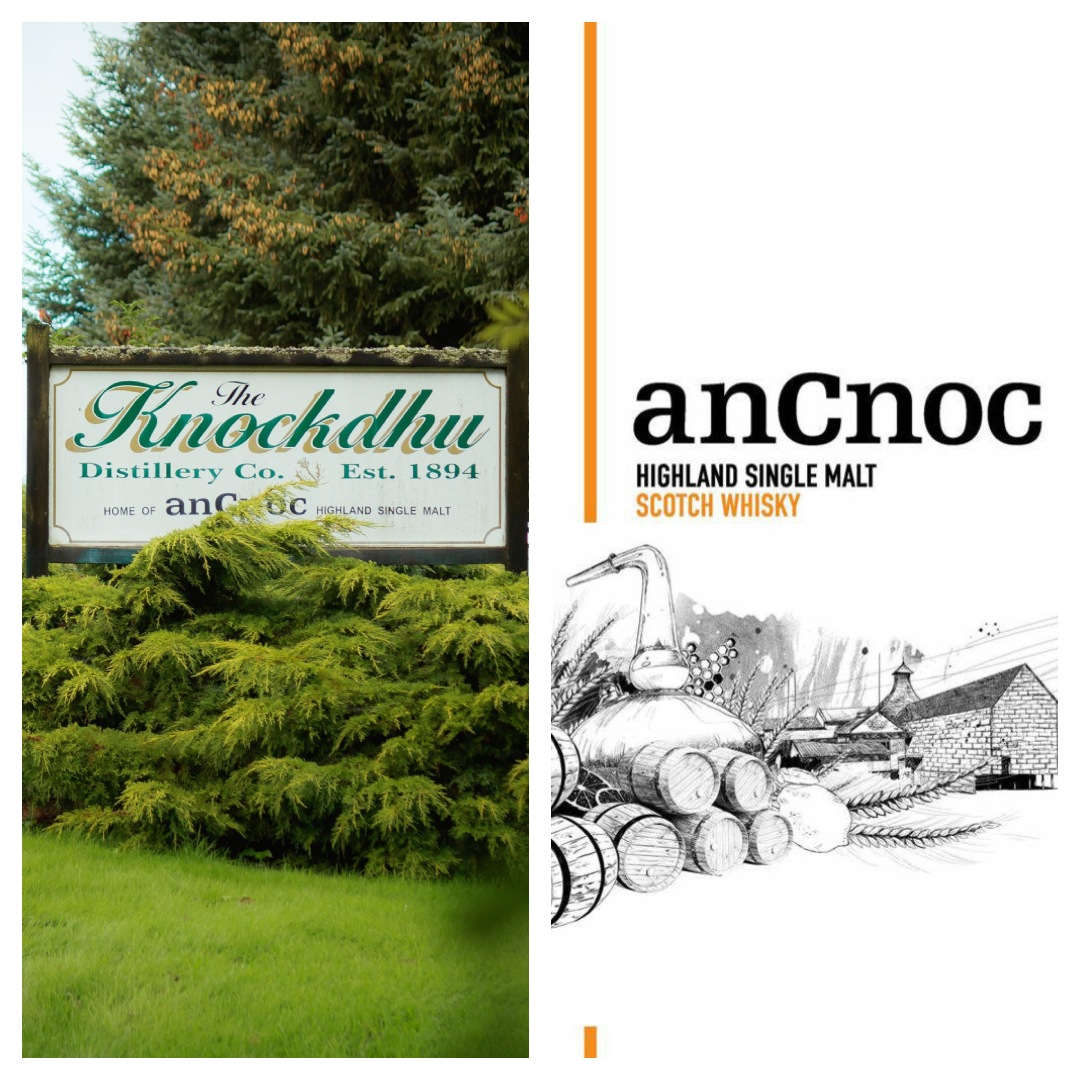
Official bottlings are not actually given the distillery name for release. Instead, they are given the name anCnoc, possibly to avoid confusion with another Scottish distillery named Knockando. Funny how attempting to avoid confusion often makes things even more confusing instead, isn’t it?
The Knockdhu Distillery resides in the village of Knock within Aberdeenshire. This puts the distillery in the East Highlands or Speyside, depending on who is drawing the regional maps. The SWA’s own Scottish Distillery map classifies Knockdhu as being within Speyside. However, the owner — Inver House — puts Highland Single Malt on each bottle of anCnoc it sells.
Distilleries located near Knockdhu include GlenDronach, which less than a 20-minute drive to the south and east, and Aultmore which is about the same length of drive to the west. Like Knockdhu/anCnoc, GlenDronach also considers itself a Highland Single Malt, and has a fetish for capitalizing a letter in the middle of its name for some reason. Aultmore is comfortable in calling itself a Speyside whisky, though. Don’t you just hate it when invisible and intangible lines are what classify things? Oh, well. What would we talk about if there weren't any arbitrary and antiquated regional concepts to make fun of?
Knockdhu has quietly produced fantastic unpeated Single Malt Scotch for quite a while. It creates a robust and rich spirit that matures nicely in both ex-Bourbon and ex-Sherry casks. Part of the reason for this might be because it is one of the distilleries that makes use of worm tubs to cool the spirit that comes off the lyne arms at the top of the stills — a worm tub made of cast iron and connected to the lyne arms that run off the spirit stills in this case.
Knockdhu plays a role in at least some of the Blended Scotch whisky brands owned by Inver House, such as Catto's, Hankey Bannister, and MacArthur's. It is also used by other blenders such as Turntable Blending House.
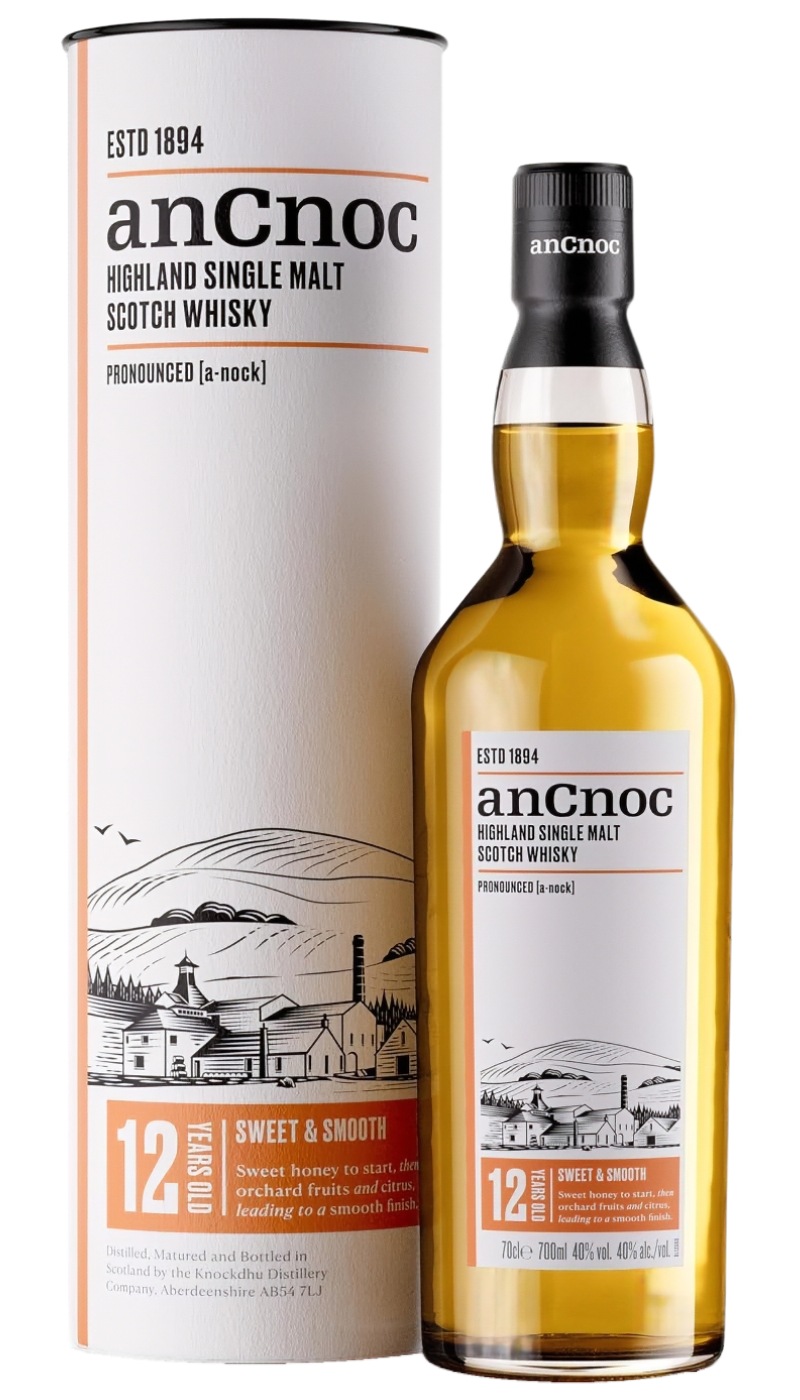
$69.99
anCnoc is Scottish Gaelic for 'the hill', which, in English is rendered 'Knockdhu' and should not be confused with the other distillery 'Knockando'. The brand decided to market itself under the label anCnoc to avoid confusion. Knockdhu is located in the Eastern Highlands not far from the town of Keith. In more recent years the whisky has been marketed heavily as a single malt, though for most of its life it has been primarily produced for blends like Haig. 40%


$329.99
Producer Note
"This is a single refill hogshead of 2006 16 year old Knockdhu. It's also very peaty and quite ridiculously pale, pure and razor-sharp. A singular and almost ideological style of whisky. The original cask strength of this one was up over 67%. Once we'd found a glass that didn't dissolve on contact with the sample, we played around with water and various strengths for ages before settling on 55% as delivering the most balance between raw peat ashes, frothy seawater, lemon juice drizzled directly over your tonsils and having pickled green olives fired at you from a blunderbuss. Why not sip it casually while playing a few rounds of BogSponge3000 down the arcade..."

$104.99
Peat and sherry is like PB&J to most peat lovers. The union creates a multidimensional whisky that becomes something more than the sum of its parts. Finding malts in this style is getting harder and harder. Great price on this anCnoc that was first matured in American Oak Barrels and Hoggies, before finishing in Sherry Butts.
Natural colour, non-chill filtered, and bottled at 46% abv.
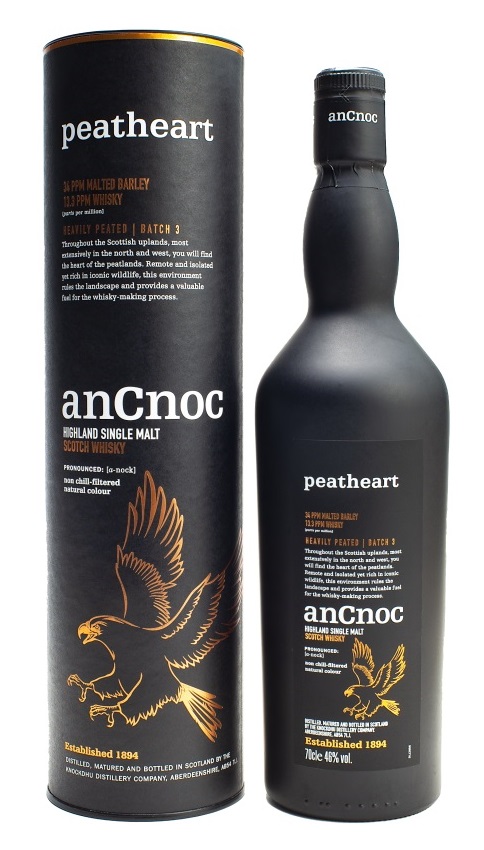
$105.99
Batch #3 of anCnoc's Peatheart series has just landed. It's been a minute or two since we saw Batch #2. anCnoc's typically unpeated style is given the rock n' roll treatment here. Expect this one to be a lot rowdier than most malts bearing the anCNoc/Knockdhu name. Peated to 34 ppm. Right around Lagavulin and Caol Ila levels. They tell us that it has been matured in "American oak barrels and hogsheads, some of which were also further matured in virgin American oak barrels."
Natural colour, non-chill filtered, and bottled at 46% abv.

