
Newsletter
Sign up for our newsletter for information on our latest products and promotions.
Sign up for our newsletter for information on our latest products and promotions.

Please confirm that you are of legal age
to purchase alcohol in your region.
You currently have an active checkout session
open already, would you like to clear it?


1257 Kensington Road NW
1 (403) 283-8000 / atyourservice@kensingtonwinemarket.com
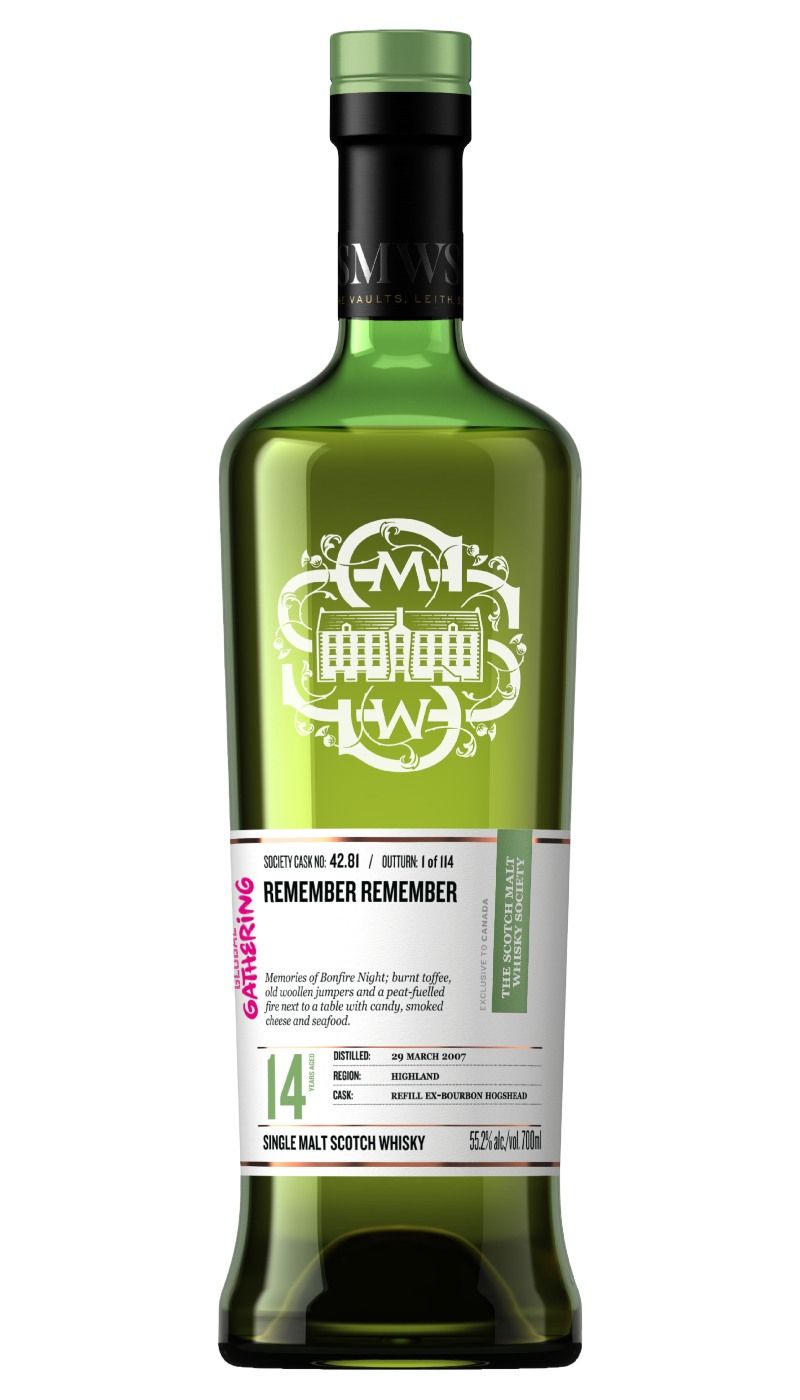
REMEMBER REMEMBER
This 14 year old Highland Islander comes in at 55.2% after being matured in a refill ex-bourbon hogshead.
Flavour profile: Peated
Distilled on: 29 March 2007
Outturn: 114 bottles
700ml mlTASTING NOTE WRITTEN BY VICTORIA BC SMWS AMBASSADOR ADAM BRADSHAW: "On the nose, childhood memories of the night before Bonfire Night – peeling sticky, slightly burnt dark treacle toffee off steel baking sheets and onto waxed paper. Making papier-mâché for the effigy, and old woollen jumpers to wear next to the bonfire. With water, foam bananas, Twiglets, and pineapple flavoured boiled sweeties.
The palate takes us to Guy Fawkes Night. Did someone throw peat on the bonfire? The blaze quickly reduces the homemade Guy to ash, as the sparklers fizz and pop in our leather gloves. Nearby the adults are smoking pipes and drinking heavily spiced peated hot toddies. The snack table is more exotic than previous years: candied lemon peels, smoked oysters, and Applewood smoked cheddar. Remember remember?"

As a Scotch Malt Whisky Society member, you will join over 40,000 other members around the world who, like our whiskies, are altogether unique. Only members can purchase SMWS whiskies (please note we are not a Scotch-of-the-Month club); you'll join a family of whisky adventurers who appreciate that their whisky discoveries taste better when shared.
SMWS Canada offers a wide variety of whiskies, and sometimes other spirits, every month. Our exclusive retail partners, including Kensington Wine Market, host tastings of our new releases every month, and members get advance notice and a discount on the ticket price.
Also available exclusively to members is Unfiltered, our award-winning online magazine that is guaranteed to provide you with fascinating insights into The Society and its events, and the world of single malt whisky.
Members also gain access to Members' Rooms in Edinburgh, Leith, London and elsewhere, and receive a discount at SMWS Partner Bars around the world.
A Club With Personality - Who Are We?
The Scotch Malt Whisky Society is a club unlike any other. Since we were formed in 1983, we've believed in doing things differently. We seek out whisky in its purest form, we prize flavour above everything else, and we're united and constant in our passion - to share the world's best whiskies, to bring them to life, and to make you proud to belong to the world's most colourful whisky club.
Our Beginnings
"The people who said it couldn't be done were so dull" - Pip Hills, Society Founder
 Our Society grew out of a few individuals' irrepressible spirit of discovery and adventure, which still drives us today. Inspired by the unique character of a cask of single malt whisky, purchased over 40 years ago from a Speyside distillery, this pioneering group of friends founded the Society in 1983 to buy more casks and share their discovery with like-minded adventurers.
The Canada Chapter of the Scotch Malt Whisky Society began its journey in October 2011. Kensington Wine Market is proud to have been its first retail partner, and continues to be the largest provider of SMWS bottles in Canada.
What We Do
Each of our whiskies must pass the uncompromising noses of our expert Tasting Panel – a secretive group of independent whisky connoisseurs from all walks of life – before being deemed worthy of an iconic Society green bottle. The exploration of flavour and sharing our discoveries is what we're all about. Our members enjoy exclusive access to our hand-picked whiskies from over 140 distilleries in Scotland and beyond. We bottle them at cask strength and offer a constant variety. How you drink them is entirely up to you.
You can find more information on the SMWS here
Browse Kensington Wine Market's current selection of SMWS bottles here
We Have Two Write Ups on Tobermory for You!
#1 The Following Artical was Written by Andrew Ferguson for Celtic Life Magazine

Though Scotland is not a very large country, it is impressive how many Scottish place names there are scattered about Canada. One of the most curious is Calgary, Canada’s 4th largest city, which takes its moniker from a white sand beach and small hamlet on the Isle of Mull. A native Calgarian, I made the pilgrimage to the original Calgary about 15 years ago, and even had a dip in the chilly waters of Calgary Bay. When I asked a couple of other tourists on the beach if they could take a photo of me in the water, they asked me where I was from. “The other Calgary” I proudly declared!
Mull is the second largest island of the Inner Hebrides on Scotland’s rugged west coast. A thousand years ago it was in the domain of the Lords of the Isles, a semi-independent kingdom of maritime raiders. Prior to the Highland Clearances of the 1700 and 1800s, the island was home to more than 10,000 people. The clearances, the potato famine of the 1840s, and emigration, reduced it to less than 3,000 by the beginning of the 20th century - about the same as it is today.
The island is a popular tourist destination with throngs of visitors taking the ferry from nearby Oban to see its many castles, beaches, the holy island of Iona, and its picturesque capital, Tobermory. Tobermory was founded in 1788 as a fishing town, during the Clearances, as part of a program to provide both work and a place to live to displaced crofters. There is, not surprisingly, a Tobermory in Canada too. The name was given to a harbour at the tip of the Bruce Peninsula in Ontario.
The original Tobermory was built around a deep natural harbour with a curious history, just off the north coast of Mull. A gold-laden Spanish galleon (possibly the Florencia), part of the failed Spanish Armada, was anchored in the port seeking provisions in 1588 when its powder magazine exploded, sending her to the muddy depths. What caused the explosion is still disputed, but there is some evidence to suggest it may have been the result of a raid to steal the gold or a dispute about compensation.
The Tobermory Distillery was built in 1798, 10 years after the town was founded and, as with many of the homes, clings to the edge of the bay.
Originally named Ledaig, pronounced [led*chig], the distillery would only operate for 40 years before closing in 1837. It was open again between 1890 and 1930, after which it sat silent for another 42 years. Like many others, the distillery was at the mercy of cyclical global demand for whisky production. It was refurbished and reopened again in 1972, only to close three years later when its owners went bankrupt.
Under fresh ownership it opened again in 1979 under a new name: Tobermory Distillers Ltd., but temporarily paused production between 1982 and 1989, the worst years of the most recent market correction. In 1993, the distillery’s fortunes turned, seemingly forever, when it was acquired by Burn Stewart Distillers, the owners of the Black Bottle Blended Scotch whisky. Today the distillery produces both peated (Ledaig) and unpeated (Tobermory) single malts, which are widely available. The peated version, Ledaig, is very rubbery and medicinal in style, and likely the only whisky more divisive amongst single malt enthusiasts than Laphroaig.
The distillery’s production is small - less than 1,000,000 litres a year - and unlikely to grow much, owing to its cramped conditions sandwiched between steep cliffs and the bay. The distillery’s stills are short but have both boil balls and very unusual lyne arms with an upward s-shaped kink. The result is a lighter spirit, though you would never suspect that after tasting Ledaig. Only a tiny fraction of the whisky is matured on site, with most of the distillery’s production matured on the mainland.
A short ferry ride from Oban, the Isle of Mull has plenty to offer visitors, not least a tour of Tobermory Distillery. The colourful buildings which ring the bay form a beautiful backdrop and make it one of Scotland’s most picturesque towns. Historic castles, black and white sand beaches, rolling hills and craggy mountains all add to its charm. Just off the coast there are two more reasons to visit. First there is the tiny holy island of Iona in the southwest, where - around its reconstructed Abbey - there are more monarchs buried than anywhere else in Europe. Second, the even smaller island of Staffa, home to Fingal’s Cave, a geologic formation connected to the Giant’s Causeway in Northern Ireland. The haunting sound of waves crashing into the cave even inspired Felix Mendelssohn to compose an overture.
#2 This information was originally written and posted by Evan on the KWM blog for our 2020 Whisky Advent Calendar.

I have not yet been to the Isle of Mull, but the town of Tobermory seems like it would picturesque town to visit. With a row of houses along the waterfront painted in bright colours, it looks like it could be located in parts of Italy or Greece if it wasn’t for the surrounding trees and foliage. The waterfront view has been used on many different UK television shows because of this.
The town Tobermory is located on the Northern part of Mull and was founded in 1788, a decade before Tobermory Distillery came to being. The town was intentionally built and engineered to be a fishing port by the British Fisheries Society. Today, the population sits around 1,000.

The distillery was founded in 1798 under the name Ledaig and has switched between that and the Tobermory name throughout its lifetime. The most recent name changes happened half a century ago in 1972 when it was revived as Ledaig. It then went back to being officially named Tobermory in 1979 and has stayed that since.
Ledaig is pronounced “Let-Chick”, or “Led-Chegg” depending on who you ask. The whisky made under this name is a heavily peated style of Single Malt Scotch and it is created by Tobermory Distillery which resides on the Isle of Mull.
The distillery lays claim to a history of spotty production. Like many Scottish distilleries, it shifted from busy to closed depending on the local and global economy and general demand for whisky. It has twice been closed for a four-decade stretch – first between 1837 and 1878 and again just last century from 1930 to 1972.
Tobermory Distillery is owned by Burn Stewart/Distell International. This company was responsible for Tobermory’s most recent closure of two years, which happened between April 2017 and June 2019. This closure was for renovations and refurbishment though, which included the replacement of two of its four stills. A new gin still was also installed during that time, though sadly the Tobermory Gin has not made its way to our neck of the woods just yet.
Distell International owns the blended Scotch Whisky known as Black Bottle and two other distilleries besides Tobermory. The Deanston Distillery in the Highlands and my personal favourite Islay Distillery: Bunnahabhain.