
Newsletter
Sign up for our newsletter for information on our latest products and promotions.
Sign up for our newsletter for information on our latest products and promotions.

Please confirm that you are of legal age
to purchase alcohol in your region.
You currently have an active checkout session
open already, would you like to clear it?


1257 Kensington Road NW
1 (403) 283-8000 / atyourservice@kensingtonwinemarket.com
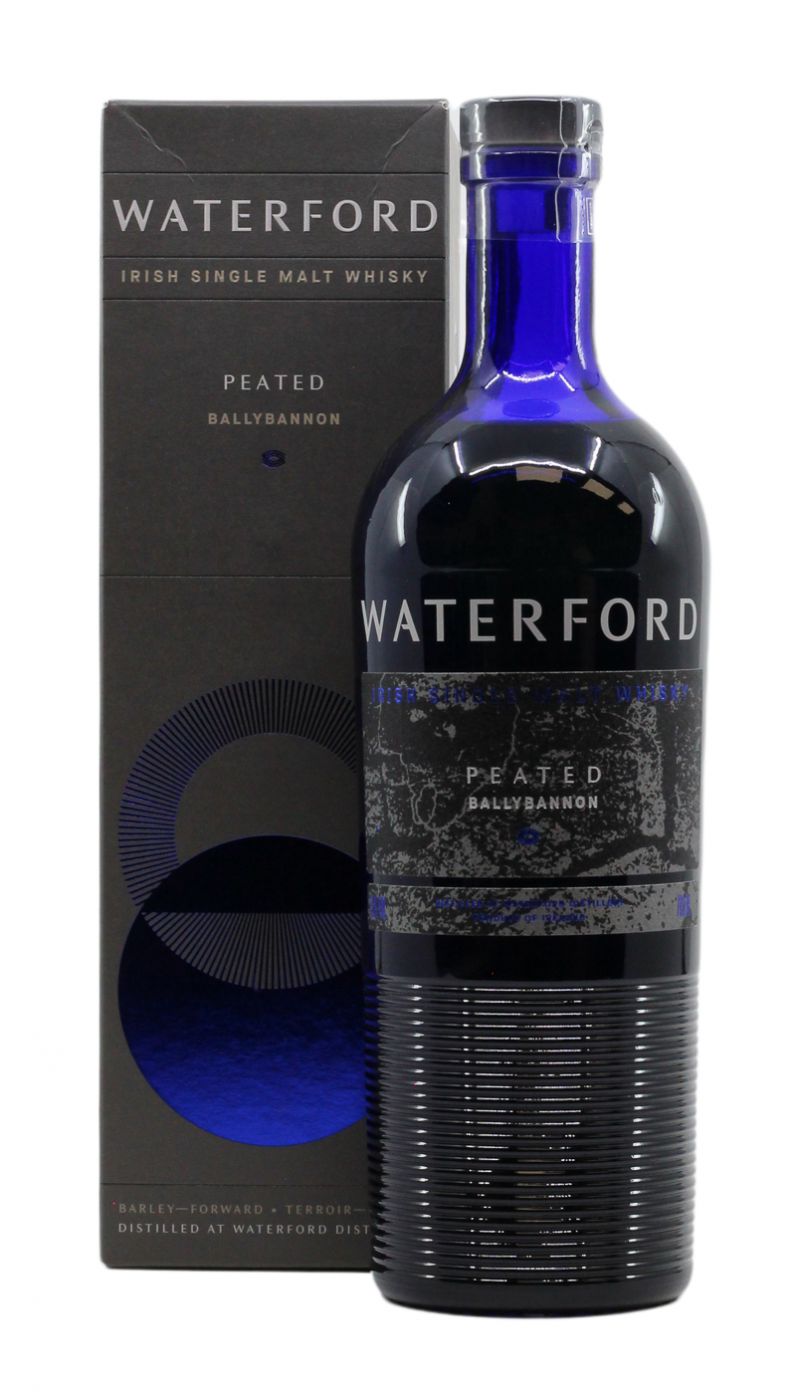
Only 48 bottles are coming to Alberta, exclusively to KWM, of one of the first peated expressions of Waterford. Produced from Laureat barley grown at Ballybannon Farm in 2017, the malt was peated to 47ppm, and was fermented for an astonishing 167 hours with Mauri yeast. The whisky was matured in first fill ex-Bourbon, Virgin American, ex-French Wine, and Vin Doux Naturelle casks. Bottled at 50%.
Producer Description
"Arcadian Barley, from our secret garden of delights, explores the natural flavours, intensity & honesty of old ways. Out of necessity since the dawn of time, peat (or turf) has been the primary fuel source in rural Ireland, with its sweet pungency familiar to generations gathered around the hearths of ancient thatched cottages. This same diffused aroma cloaked barley dried over peat smoke by illicit distillers, a custom that died out in the 1850s.
"Ballybannon in Co. Carlow could be the perfect terroir for growing barley for peating. Sitting on raised ground along the banks of the River Barrow, its heavy, lime-rich soils — archetypal Elton series — are directly adjacent to sphagnum-dense inland bog. Small wonder then that the Pender family’s barley and peat from Niall Carroll’s Ballyteige cuttings in Co. Kildare have proven such a natural combination. Such is Ballybannon barley’s natural affinity for peat, that we have been able to kiln-dry it to a high 47ppm and still find that the character of Ballybannon’s terroir itself remains the dominant flavour in the spirit. Along with its sister bottling, Fenniscourt, Peated Ballybannon represents the first marriage of Irish barley and Irish peat in generations."
Cask Compostition
39% FIRST FILL AMERICAN
21% VIRGIN AMERICAN
21% PREMIUM FRENCH
19% VIN DOUX NATURAL
Producer Tasting Note
Nose: Soft peat, almonds, crisp, lavender honey, reminds me of a seaside escape, driftwood fire smoke, green apples, padrón peppers, salt crust, a morning walk on a fresh day.
Taste: Peat kick, very chewable, BBQ fish by the sea, buttery, warm apple and almond tart with honeycomb ice cream, wool, frangipane, samphire.
Finish: What finish?!
The following was written by Andrew Ferguson for the April 2021 Edition of Celtic Life Magazine
The Irish whiskey industry is going through a renaissance at the moment, and no distillery better exemplifies this than Mark Reynier’s Waterford Distillery.

Waterford was opened in 2015, in the recently decommissioned Waterford Brewery, in the town of the same name, about 100 miles south of Dublin. The original brewery opened in 1792 but was replaced in 2004 with a state-of-the-art facility built by Diageo at huge expense to brew Guinness. It was closed in 2013, with the site put up for sale after Diageo opened yet another massive new brewery at St. James Gate in Dublin. And that is where Mark Reynier enters the picture.
Before we wade into the deep end of Waterford, we need to first touch on Bruichladdich, the plucky distillery on Scotland’s west coast Isle of Islay. Bruichladdich, which originally dates to 1883, was in a sorry state at the end of the 20th Century. In 2000, the distillery was purchased by Murray McDavid, an independent bottler headed by Mark Reynier, a former London wine merchant. When Bruichladdich was brought back to life a lot of focus was put on barley, terroir, and cask selection. Since its revival in 2000, Bruichladdich has only ever made whisky with Scottish barley, and has managed to source up to 40 per cent of its annual production from Islay - a considerable feat considering the stormbattered island is not exactly ideal for cultivating barley. Bruichladdich worked closely with local farmers to achieve this. Reviving Bruichladdich wasn’t easy, but in 2012 the distillery was sold to Remy Cointreau for an impressive £58,000,000.00.

Mark did not want to sell as he was just starting to see the fruits of his labours at Bruichladdich. His passion and curiosity about the role terroir played in whisky was born during his time in the wine trade. But in 2012 he found himself looking for a new challenge, still full of passion, and with some capital in hand. In 2015, along with some investors, Mark bought the old Waterford Brewery from Diageo, and began converting it into a distillery. That same year he began sourcing barley from Irish farms, playing close detail to what they creatively call Téireoir; a blend of the French word terroir and Éire, the Irish word for Ireland. Impressively the first spirit trickled off the stills in January of 2016.
The distillery takes barley and téireoir very seriously, storing the production from individual farms and harvests separately. The distillery tracks huge amounts of data on all of its barley, including the soil and growing conditions. They even employ their own fulltime agronomist to analyze the data to see how the terroir influences flavour development. Waterford is uniquely outfitted with a wet mill and a mash filter, pieces of equipment found in few other malt whisky distilleries, but which may be huge assets. The distillery employs a long fermentation by industry standards, tweaking it depending on the barley’s traits.
Distillation is also slow and precise, resulting in a very fruity spirit with distinct profiles to reflect the barley and its téireoir.
The whisky is matured in only fresh oak, including a mix of ex-Bourbon, Virgin American Oak, ex-French Oak wine barriques, and Mark’s prized Vin Doux Naturel casks.
The first Waterford whisky was launched in March of 2020, just as the COVID-19 pandemic was taking hold. The distillery wasn’t able to give its whisky the launch they wanted, but it has quickly caught on internationally, garnering high praise from respected critics and experts. Over the last year Waterford has released at least two dozen different whiskies, mostly Single Farm Origin Single Malts, each produced from a single harvest at a single Irish farm. There have also been two releases of the “Arcadian Series Organic Gaia” single malts, as well as their first Cuvee called Lómhar, which is Irish Gaelic for ‘gem.’

I had the pleasure to visit Waterford in early March last year, just before the world turned upside down. It was nice seeing Mark Reynier again, whom I have known for nearly two decades from his time at Bruichladdich. The distillery is impressive, both technically and aesthetically, with a great team. Waterford is a distillery to keep your eye on; the spirit it is producing is world class, and they are filling it in to good quality wood. While I am not yet a true believer in the concept of barley terroir, I do think Waterford is following a recipe for success. High quality barley, long fermentations and precise distillations combined with a great wood policy is as good recipe for world class whisky as I can think of, and the proof is in the pudding. The first whiskies may be young, but they are excellent!

Waterford Distillery can be visited, but only by appointment. The whisky is currently available in Alberta and British Columbia in Canada, as well as in a handful of American states.