
Newsletter
Sign up for our newsletter for information on our latest products and promotions.
Sign up for our newsletter for information on our latest products and promotions.

Please confirm that you are of legal age
to purchase alcohol in your region.
You currently have an active checkout session
open already, would you like to clear it?


1257 Kensington Road NW
1 (403) 283-8000 / atyourservice@kensingtonwinemarket.com
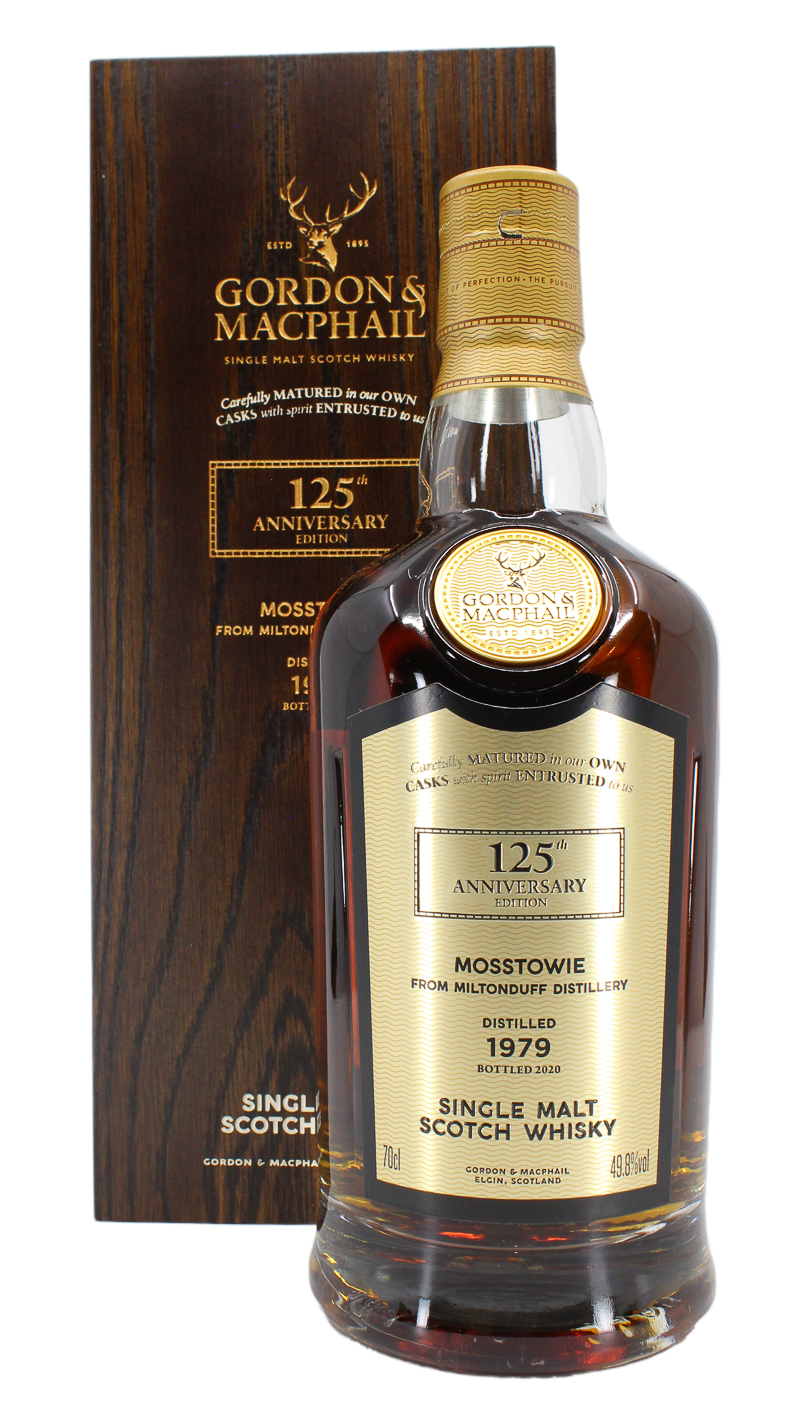
The first Mosstowie we've seen in a couple of years, this 40 year old is part of Gordon Macphail's 125th Anniversary Editions. Matured in a Refill Sherry Hogshead, the whisky has been bottled at 49.1%. Mosstowie is a single malt produced at the Miltonduff Distillery between 1964 and 1981. Only 6 bottles are coming to KWM, Limit 1 Per Customer! 90pts Angus & 89pts Serge @ Whisky Fun.
Producer Description
"The penultimate of the 125th anniversary whiskies to be released is the Gordon & MacPhail 1979 Mosstowie from Miltonduff Distillery. Located within Miltonduff Distillery in Morayshire, Mosstowie was founded in 1964 under the ownership of industry pioneer Hiram Walker – who championed the use of longer, more versatile Lomond Stills to give a variety of flavour profiles. This stills, which produced Mosstowie’s smoky, soft spirit operated for just 17 years as the longer arms of the stills were notoriously difficult to clean, resulting in their removal in 1981. Only 164 bottles are available worldwide of this full-bodied whisky, full of sherry influences and dark chocolate notes. The 40-year-old whisky was laid down in Gordon & MacPhail’s Elgin warehouse on Thursday 13 September 1979 in cask number 20323, a refill Sherry Hogshead."
700 mlProducer Tasting Note
Nose: Sweet butterscotch, ripe fruit and subtle floral aromas. Caramelised sugar develops alongside waxy citrus peel, slowly transforming into fresh guava.
Taste: Intensely sweet; fruity flavours of apricot and cooked apple with a subtle mouth-warming chilli spice edge. Subtle charred oak flavours give way to a soft undertone of mint leaves.
Finish: A medium finish with sweet and ripe autumnal fruit and a lingering dry herbal note.
90pts Angus @ Whisky Fun
"Mosstowie was, of course, a single malt produced on Lomond stills at Miltonduff distillery between 1964 and 1981. Colour: deep gold. Nose: shy at first with a slowly unfurling resinous quality that takes in long-brewed fruit teas, lemon infused olive oil, hessian and citronella wax. Indeed, these lemon and tea impressions continue to grow with time. I also find some matcha, pot pourri, sandalwood and very subtle notes of dried tarragon, bergamot and lapsing souchong. Fragility but also complexity - an undeniably compelling combination that forces you to pay attention. In time more obvious and classical notes of waxes, polish and honeys emerge. Mouth: it’s cool how Mosstowie - always a rather funny make - remains charmingly unusual even at this kind of age. There’s an initial punch of white pepper, but also pressed wildflowers, strong green tea, slightly bitter herbal notes, greengage, lamp oil and some rather umami and savoury notes like bouillon and mushroom powder. This deceptive lightness certainly harbours complexity. As on the palate it evolves more towards honeys, pollens and various fruit resins. Bitter citrus fruit piths, kumquat, grapefruit and herbal teas again. Finish: long, leafy, peppery, bitter fruits, dried tarragon, wormwood, more assorted teas and a warming, herbal and once again resinous aftertaste. Comments: The kind of whisky that you could just totally miss if you came across it mid-session with many other more obvious whiskies on the table. But there is a shyness, a sense of charm and almost an invitation about this whisky that is worth taking time over. I find this fragile complexity extremely beautiful. SGP: 551 - 90 points."
89pts Serge @ Whisky Fun
"So this one was made at Miltonduff. Colour: gold. Nose: much, much more than just a curiosity, and an arrival that would be rather all on subtle saps and resins, perhaps pink bananas, then beeswax indeed, earl grey and baklavas, other oriental pastries, putty, marzipan and some high-end green/blue tea, Wulong, perhaps even white tea (tips)… The subtlety is just very charming, this one never shouts out, and yet it’s absolutely not ‘empty’, this is not grain whisky at all – despite the use of columns. After ten minutes, more custard with some genuine, natural vanilla. Not lab vanilla. Mouth: many teas, I would say. The Wulong got stronger, we’re also finding chamomile and linden tea, certainly orange blossom, then vivid notes of pistachios (pistachio syrup, love it or hate it – I adore), grapefruit skins, and a rather soft, greenish, resinous oak. I would have said mizunara a.k.a. Mongolian oak, but I don’t think they had invented it yet. I mean, for coopering. There’s more and more green tea, while some funny touches of strawberry sweets start to make it through. Funny indeed, but not uncommon in my book. Finish: perhaps a tad short but still charming. Turkish delights, marzipan, mint-flavoured nougat… Comments: charming, subtle whisky indeed. Again, much more than just a curiosity. SGP:461 - 89 points."
Adapted from an article written for Celtic Life Magazine by Andrew Ferguson:
In 1895 James Gordon and John Alexander MacPhail opened a grocery business in the City of Elgin, the heart of Scotland’s Speyside whisky region. The business sold groceries, tea, coffee and wines from all over the world. 125 years later, Gordon & MacPhail still operates the grocery business in Elgin, but its real enterprise is as an Independent Bottler and Distiller of Scotch Whisky.

In the early years of the business Gordon and MacPhail brought in a young John Urquhart as apprentice. Urquhart had a knack for selecting and blending whiskies from local distilleries. He also began brokering casks and independently bottling single malt from famous distilleries like Glenlivet, Mortlach and Glen Grant. The practice of filling casks of new make whisky, rather than simply purchasing mature casks began at this time. This is something which sets Gordon MacPhail apart from almost all other independent bottlers to this day, and it gave them a leg up through leaner years. In 1915 John Urquhart was made senior partner, and though the firm would keep its name, from this point on it would remain privately owned by the Urquhart family.
In 1933 George Urquhart, aka “Mr. George”, joined his father in the business. He was heavily involved in the firm’s whisky business, travelling widely to showcase Gordon & MacPhail whiskies. G&M’s business thrived during and after World War II. Having had the foresight to lay down large numbers of casks in the 1930s and early 1940s, they were in a strong position to meet demand, especially in America. This was a difficult time for most of the industry with barley rationing dramatically reducing distilling.

In 1968, under George Urquhart’s leadership, Gordon & MacPhail launched the Connoisseurs Choice range. At a time when few distilleries were bottling their own whisky as single malt (rather producing it for use in Blended Scotch whiskies), Gordon & MacPhail began marketing single malts from distilleries across Scotland. The range is still being bottled today.
The third generation began entering the business with George’s son Ian Urquhart in 1967. He was joined by David Urquhart in 1972, as well as Michael Urquhart and Rosemary Rankin in 1981. The family firm continued to thrive even during the industry downturn of the 1980s and ear 90’s, emerging as the undisputed preeminent independent bottler of Scotch whisky. In the 2010s the torch was passed to the 4th generation, with at least five of John Urquhart’s descendants now involved in the business.
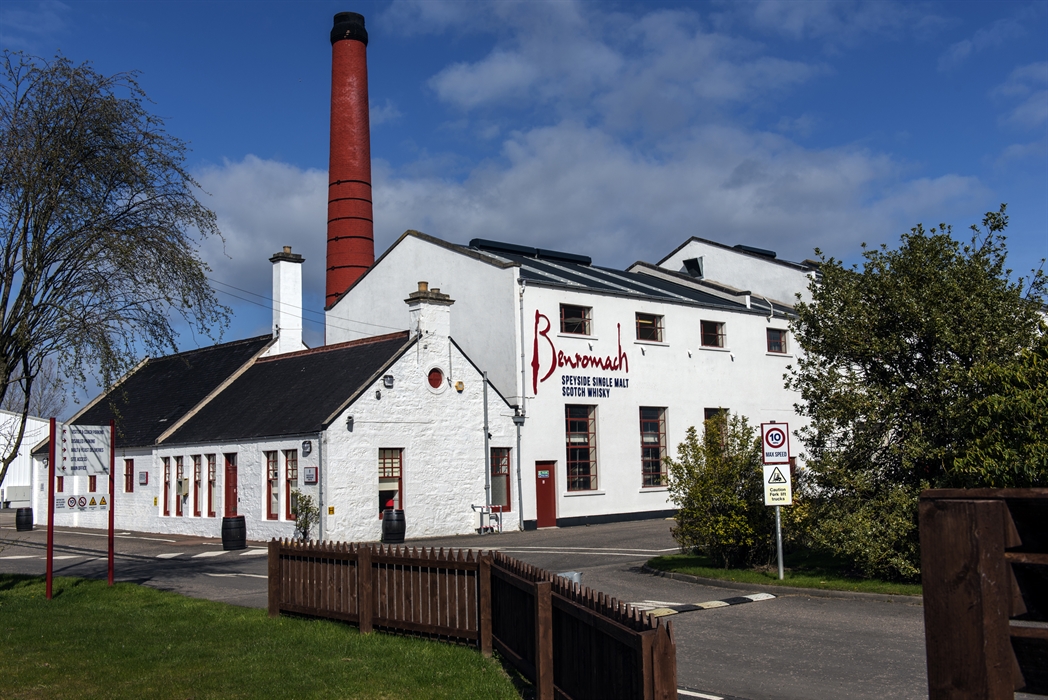
It had always been John Urquhart’s vision for the family to own a distillery of its own. The dream was finally realized in 1993 with the acquisition of the closed Benromach Distillery in the nearby town of Forres. The distillery was in rough shape, and it took nearly 5 years to get it up and running. HRH Prince Charles was on hand in 1998 for its official reopening. Never content to rest on their laurels, the firm announced plans in 2019 to open a brand-new distillery in the Cairngorms National Park. The Cairn Distillery is scheduled to open in 2022.
One of the most remarkable things about Gordon & MacPhail is the vision it had to mature whiskies to great ages. Few other whisky firms, whether distilleries or independent bottlers, have ever had the foresight to mature casks for more than 30 or 40 years. In 2010 G&M bottled the Generations Mortlach 70 Years Old, which was the oldest whisky ever bottled at the time. They followed up on that milestone by bottling 70-year-old Glenlivet in both 2011 and 2012. And then in 2015 they once again they raised the bar by bottling the Generations Mortlach 75 Year. Of the 10 oldest whiskies ever bottled, all but 2 have been bottled by G&M.

It is almost certain that Gordon MacPhail will one day bottle the first ever one-hundred-year-old whisky, but that may still be a couple of decades away. Their oldest maturing stocks are from the late 1930s and early 1940s. A number of these casks, 15 First Fill Sherry Butts to be precise, were filled for Gordon & MacPhail at the Glenlivet Distillery on February 3rd, 1940. Most of these casks have been bottled over the decades, but G&M dipped into another of these casks this year to bottle another whisky. The Generations Glenlivet 80 Year, once more the oldest bottle of Scotch Whisky ever bottled. It isn’t inexpensive, but I can vouch for it in one regard… it doesn’t disappoint!
Gordon & MacPhail whiskies can be found all over the world with whiskies ranging from under $100 to $100,000.00 or more. Their grocery shop in Elgin is the brand's spiritual home, with a section dedicated to Scotch Whisky that showcases more than 1000 bottles. Prior to Covid-19 the shop offered both tastings and in-store sampling. As does their nearby Benromach Distillery in Forres, one of the smallest and most traditional distilleries in the Speyside.

$2724.99
Bottled as a part of Signatory's 30th Anniversary range, this 1973 Mosstowie, from the Miltonduff Distillery, was filled into a Refill Sherry Butt and bottled after 45 years at 51.6%. 91.94pts Whisky Base and 92pts from Angus @WhiskyFun and


$3799.99
Glenlochy is a closed distillery, and we don't see its whisky very often anymore. This Signatory single cask, was from Hogshead #3232, and was bottled after 35 years at 51.1%. 92.42pts Whisky Base and 93pts Whisky Fun (tasting note below).

$2849.99
Distilled in 1973 and filled in to a Refill Sherry Butt, the cask, No. 2518, was bottled after 45 years at 45.4%. Supposedly peated Glen Keith, no one is really 100% sure where it came from as Strathisla has also been suggested. Regardless, this is a peated malt, but an old one. 91pts Whisky Fun (See Tasting Note Below)!
A Very Curious Whisky
It is also one of the most unusual, controversial and hard to find Scotch whiskies. Independent bottler Signatory, the only company to have ever bottled Craigduff as a single, claims it is a curious double peated Glen Keith. But Chivas Brothers, who own both Glen Keith and Strathisla, have always insisted it is actually from the latter. Regardless of its origin, Craigduff was said to be double peated on account that both lightly peated malt was used, as well as “concentrated peated water” which was added to the charge in the wash still. Curious and controversial stuff it would seem!